01
Local fidelity
Sliding-window attention retains high-resolution recent chunks for motion, texture, and clean chunk boundaries.
A hybrid memory architecture that keeps recent video detail close, compresses older history by timescale, and adapts a compact global state online.
Video world models must preserve scene layout, object identity, motion, and camera trajectory across hundreds of frames. Full attention is too expensive; a short local window is efficient but forgetful.
HippoCampus processes video autoregressively in fixed-length chunks and separates memory into complementary roles. Recent chunks remain explicit for visual continuity, older history is compressed at multiple resolutions, and a lightweight fast-weight memory adapts to the current scene during inference. The pretrained video backbone stays frozen while only the memory state evolves.
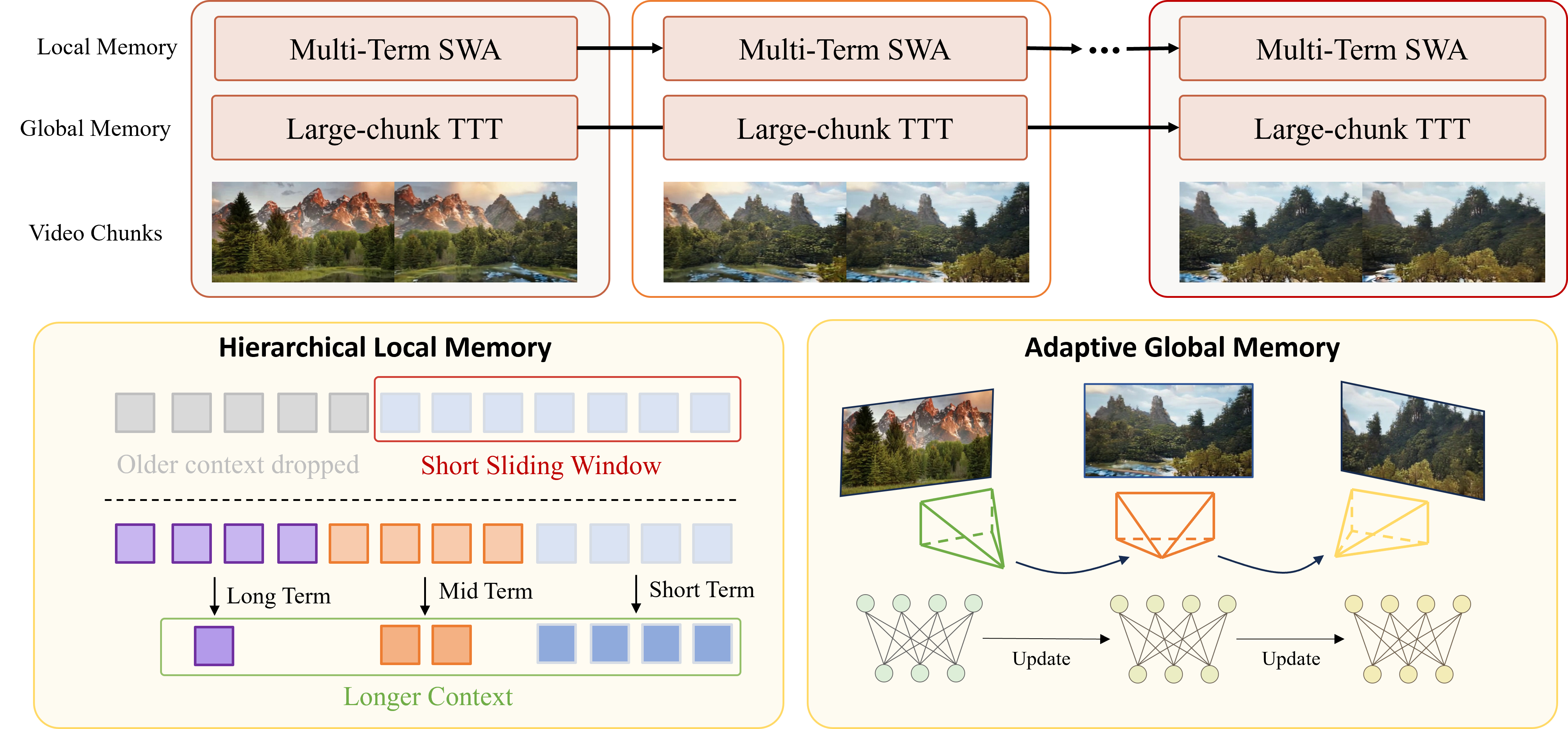
Sliding-window attention retains high-resolution recent chunks for motion, texture, and clean chunk boundaries.
Short-, mid-, and long-term tokens are compressed progressively to extend usable history at bounded cost.
Test-time fast weights store scene-specific information without a key-value cache that grows with the rollout.
The central design principle is simple: keep the recent past detailed, make older history compact, and let global memory specialize to the scene.
The model fuses hierarchical spatio-temporal tokens with a parametric test-time memory before predicting the next action-conditioned video chunk.
History is split into short-, mid-, and long-term regimes. Three-dimensional convolutional compressors use increasingly strong compression for older chunks, reducing token cost while retaining a longer effective context.
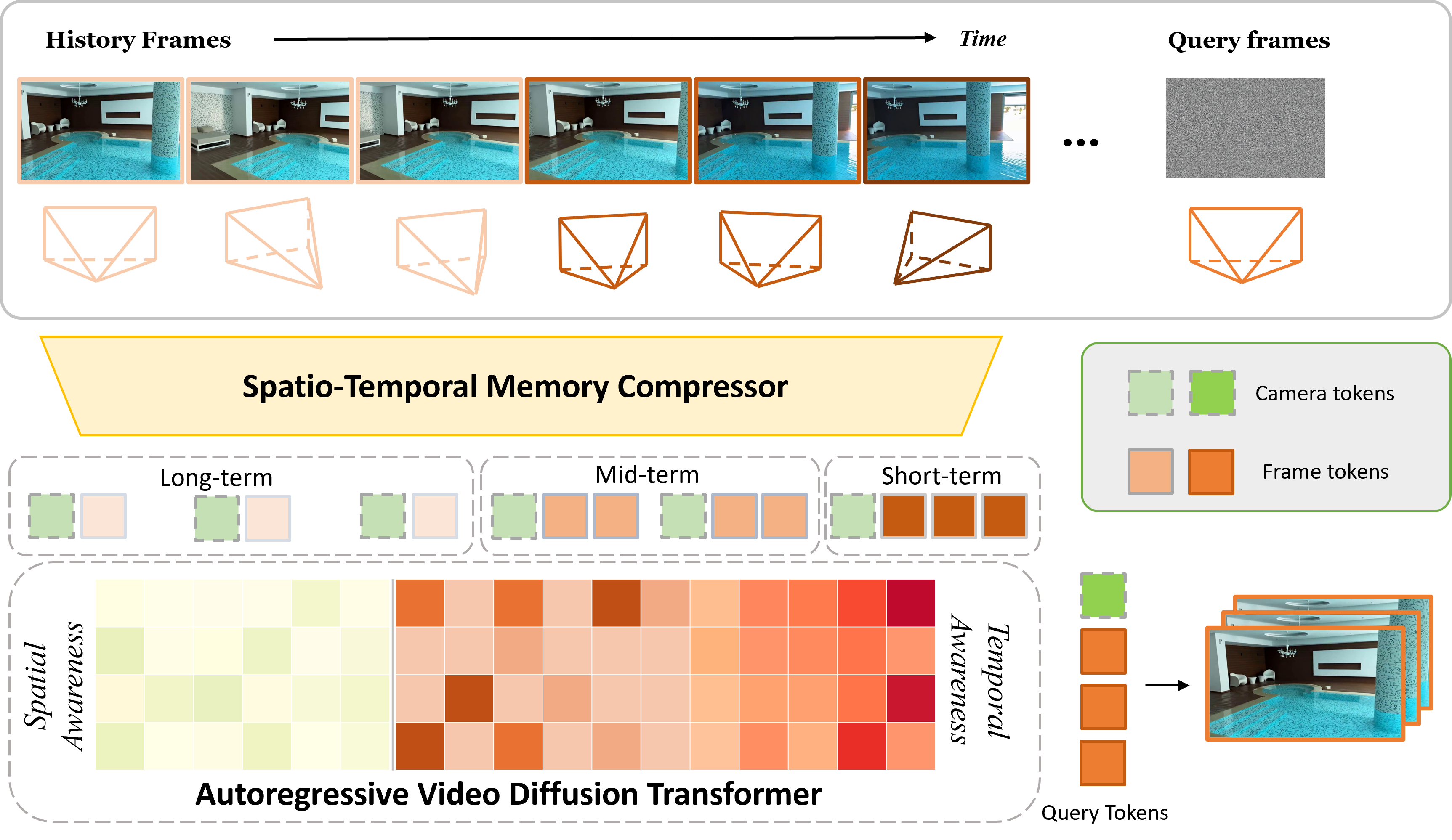
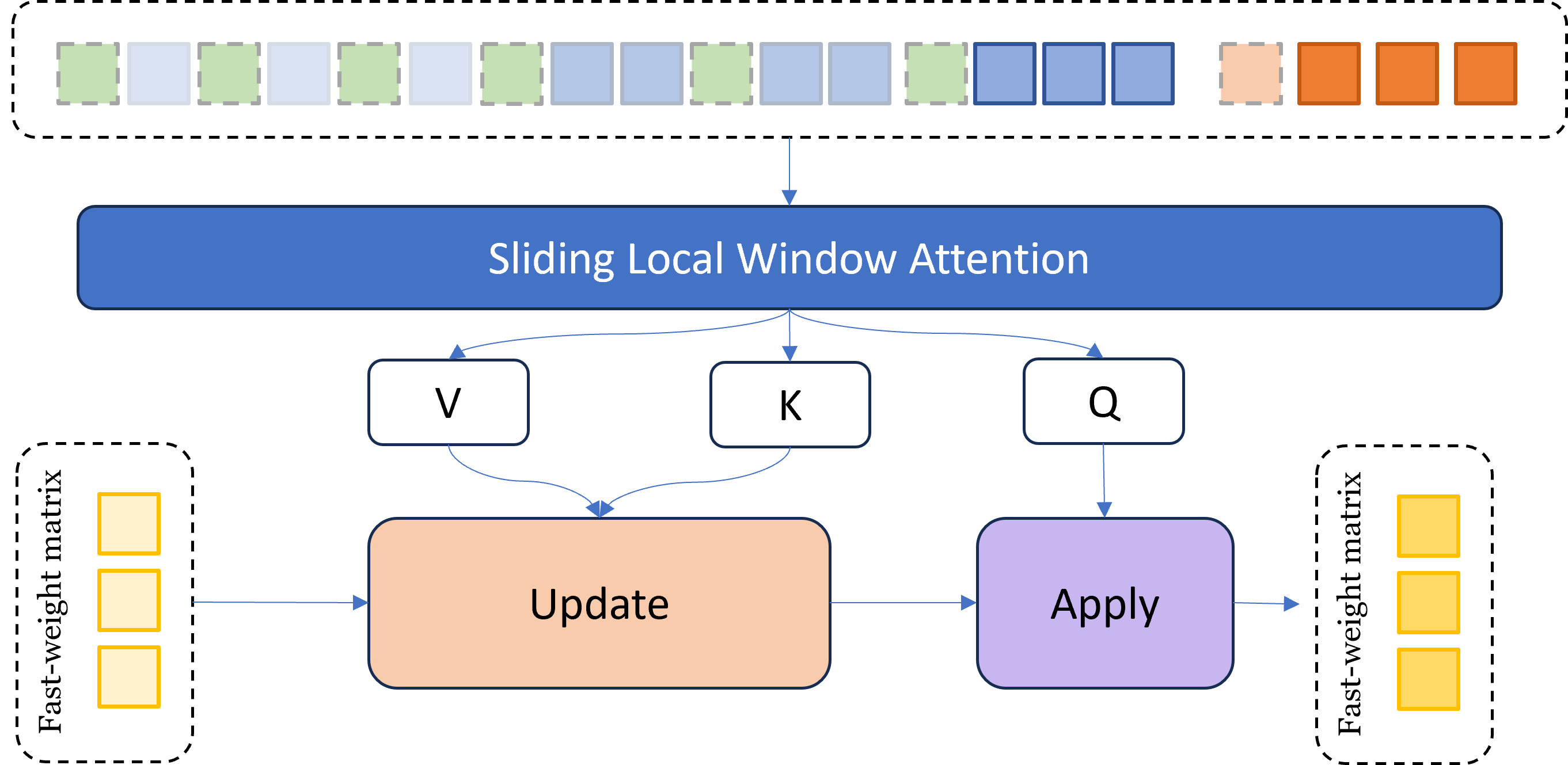
A lightweight neural memory is updated online using a self-supervised latent prediction objective. The fast weights form a fixed-size parametric summary that evolves from chunk to chunk, preserving scene layout, identities, motion patterns, and long-range dependencies.
Prediction stays causal: HippoCampus reads the current memory to generate the next chunk, then updates memory from the newly available observation. This avoids retaining every historical token.
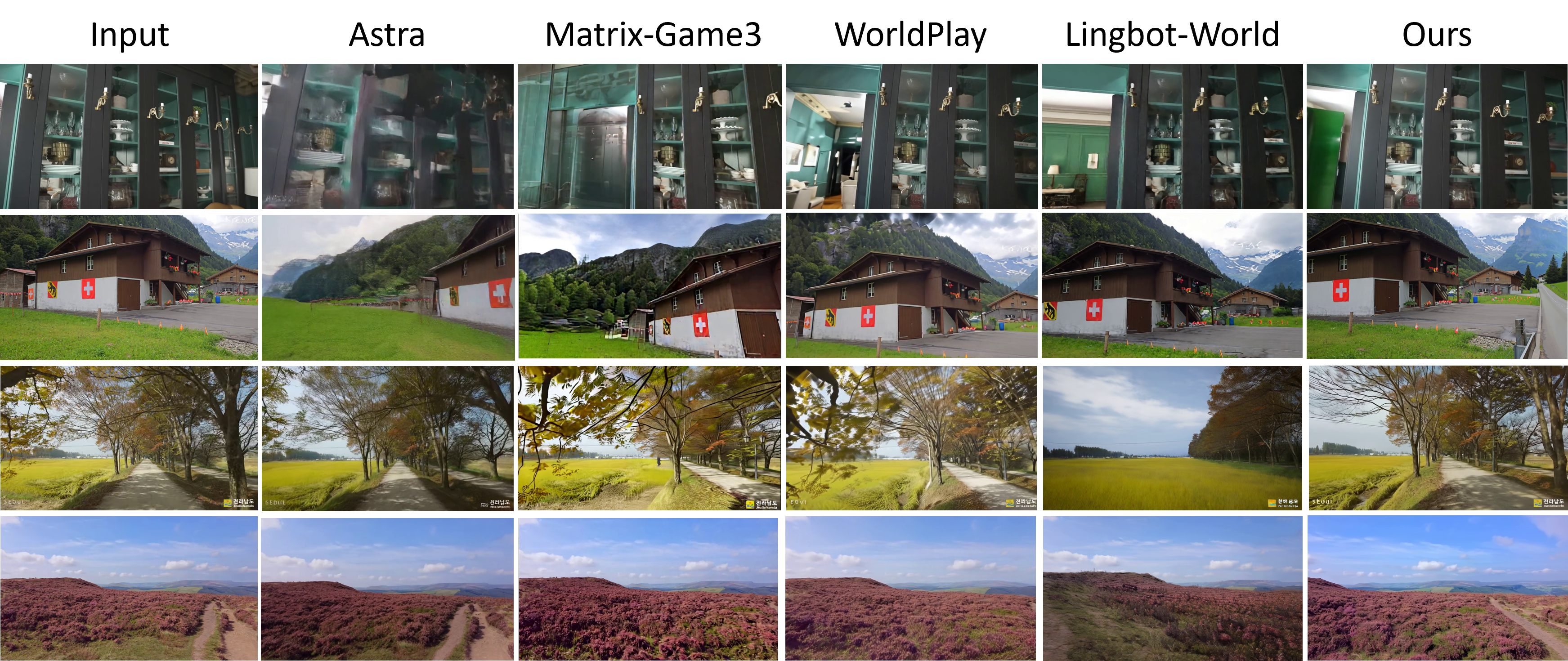
HippoBench tests whether a world model remembers across long rollouts—not just whether its next few frames look plausible.
The benchmark contains 100 scene-disjoint held-out clips spanning structured driving, in-the-wild exploration, camera-controlled videos, and simulation. Difficulty increases with rollout length, viewpoint change, dynamic content, and spatial revisits.
Shorter rollouts, mild viewpoint change, and few or no revisits.
Longer rollouts with moderate camera motion or partial revisits.
Long rollouts, large viewpoint changes, or repeated revisits.
HippoCampus leads all reported visual-quality and consistency metrics across Easy, Medium, and Hard. Its largest gains appear in FVD and LPIPS.
| Method | ATE RMSE ↓ | FID ↓ | FVD ↓ | PSNR ↑ | LPIPS ↓ |
|---|---|---|---|---|---|
| Astra | 0.84 | 45.6 | 210.4 | 23.8 | 0.212 |
| Matrix-Game 2.0 | 0.80 | 50.3 | 236.2 | 23.1 | 0.219 |
| Matrix-Game 3.0 | 0.79 | 47.8 | 220.5 | 23.5 | 0.205 |
| HY-WorldPlay | 0.73 | 42.1 | 208.9 | 24.4 | 0.190 |
| Lingbot World | 0.80 | 39.2 | 185.7 | 24.6 | 0.188 |
| HippoCampus | 0.70 | 37.2 | 124.2 | 24.9 | 0.175 |
| Method | ATE RMSE ↓ | FID ↓ | FVD ↓ | PSNR ↑ | LPIPS ↓ |
|---|---|---|---|---|---|
| Astra | 0.95 | 63.9 | 330.4 | 21.8 | 0.281 |
| Matrix-Game 2.0 | 0.92 | 60.5 | 310.8 | 22.1 | 0.268 |
| Matrix-Game 3.0 | 0.90 | 58.7 | 300.9 | 22.3 | 0.256 |
| HY-WorldPlay | 0.73 | 45.1 | 214.2 | 23.7 | 0.201 |
| Lingbot World | 0.81 | 48.7 | 284.2 | 24.0 | 0.194 |
| HippoCampus | 0.74 | 41.6 | 182.7 | 24.2 | 0.182 |
| Method | ATE RMSE ↓ | FID ↓ | FVD ↓ | PSNR ↑ | LPIPS ↓ |
|---|---|---|---|---|---|
| Astra | 1.18 | 82.7 | 495.1 | 17.9 | 0.358 |
| Matrix-Game 2.0 | 1.12 | 78.4 | 460.2 | 18.5 | 0.342 |
| Matrix-Game 3.0 | 1.10 | 76.8 | 445.9 | 19.8 | 0.333 |
| HY-WorldPlay | 0.81 | 58.9 | 301.1 | 21.0 | 0.321 |
| Lingbot World | 0.93 | 54.6 | 285.8 | 21.4 | 0.309 |
| HippoCampus | 0.89 | 52.9 | 268.3 | 22.7 | 0.244 |
Lower is better for ATE RMSE, FID, FVD, and LPIPS; higher is better for PSNR. HY-WorldPlay has the lowest ATE RMSE on Medium and Hard, while HippoCampus remains competitive on control and leads the visual metrics.
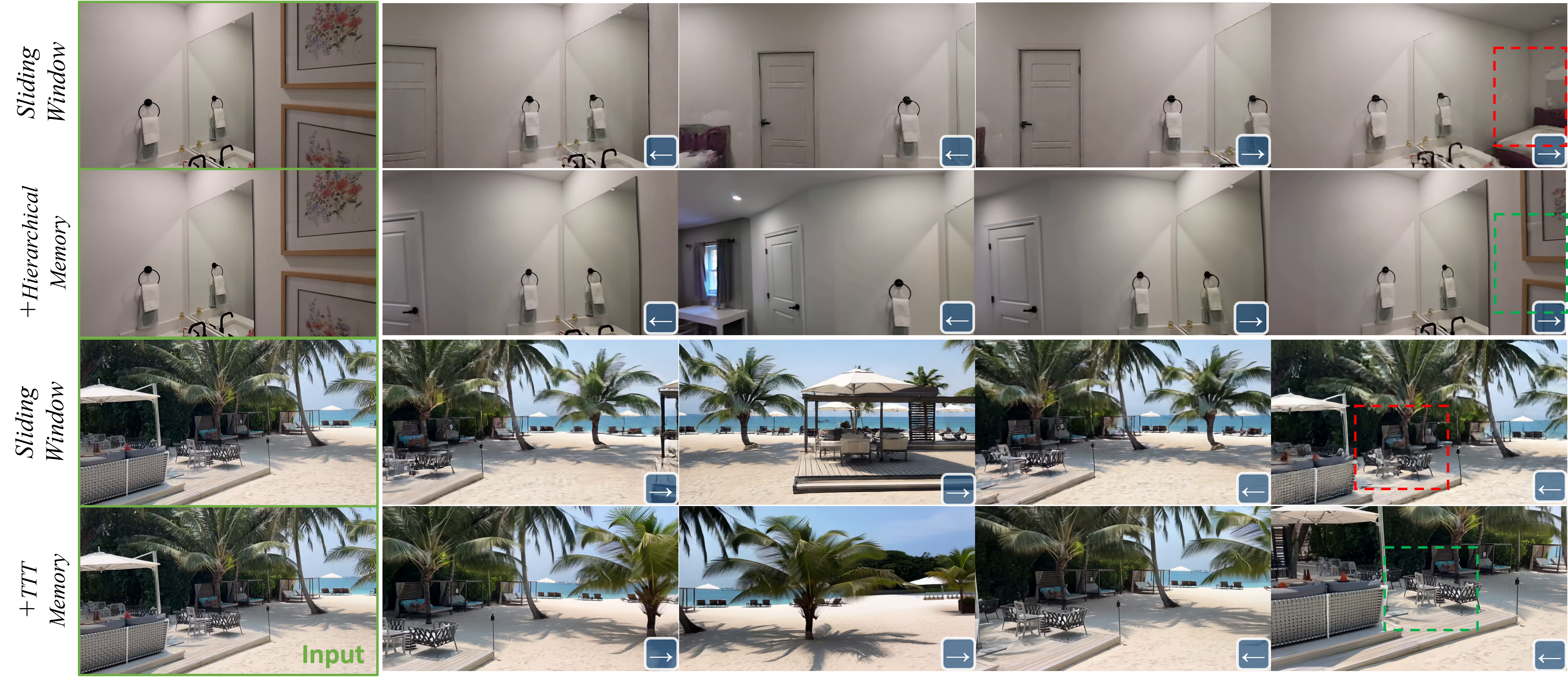
Hierarchical memory supplies the largest improvement over a local window; adaptive test-time memory adds a further consistent gain across perception, reconstruction, and control metrics.
| Configuration | FVD ↓ | LPIPS ↓ | PSNR ↑ | ATE ↓ |
|---|---|---|---|---|
| Sliding window | 214.7 | 0.379 | 21.28 | 1.37 |
| + Hierarchical memory | 138.2 | 0.191 | 24.42 | 0.93 |
| + TTT memory | 124.2 | 0.175 | 24.96 | 0.70 |
All variants use the same backbone, tokenizer, data, rollout length, and action inputs on HippoBench Easy.
Adaptive memory offers a practical path to longer video horizons for autonomous driving, robotics, and embodied simulation.
Online updates add inference latency and depend on the self-supervised objective. Prediction errors may be reinforced, and rare events or complex physical interactions remain challenging.
Long-horizon generation should be paired with provenance tracking, careful validation in safety-critical settings, and license-compliant benchmark metadata.
Citation information for the HippoCampus project.
@misc{peng2026hippocampus,
  title   = {HippoCampus: Hierarchical Memory for Long-Horizon Video World Models},
  author  = {Peng, Chensheng and Cai, Yuanhao and Zhang, Chenyang and
             Zeng, Belinda and Jia, Menglin},
  year    = {2026}
}